Hargeisa, Somaliland +252 639416857 Soomaali
Maahiigaan Mineral Company Book a visit
Learn

Know your stone.

Answers to the most common questions, short illustrated lessons, and the photo guide for remote advice. Specimen pictures are educational illustrations, not specimen evidence.

FAQ

Frequently asked questions


How do I book an appointment?

Fill in the form on the Book a visit page, then send the request to the laboratory on WhatsApp (+252 639416857). We confirm the time with you. You can also call the laboratory.

How long does testing take?

Selected Phase 1 checks can take as little as 10 minutes. Allow one hour for full testing with a certificate. Complex cases may need advanced testing and more time.

How much does it cost?

We offer packages from initial advice to a full certificate. Ask for prices on WhatsApp before your visit. If you sell your rough gemstone to us, you pay no testing fee.

Will a quick test tell me if my stone is natural?

No. Phases 1 and 2 are preliminary; they cannot reliably establish natural or synthetic status or identify treatments. Those findings and a certificate require full testing (Phases 3 and 4).

My stone is already cut. Can I get a certificate?

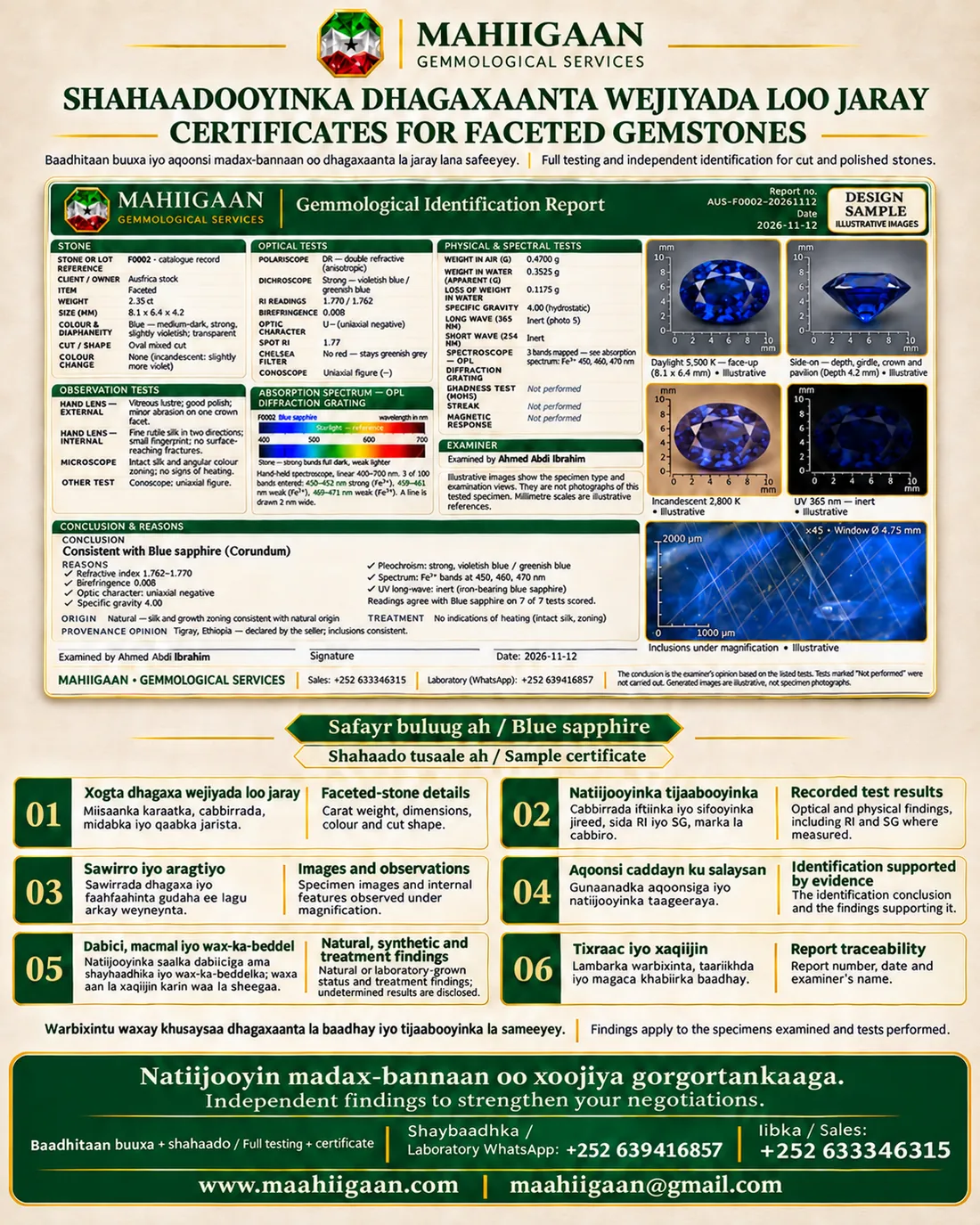
Yes. We offer full testing and certificates for faceted gemstones, recording carat weight, dimensions, colour, cut shape and identification findings.

Can you tell me what my stone is worth?

Our reports identify the stone and record the test findings; they are not a monetary appraisal and do not guarantee a sale price. Independent findings do help you negotiate with wholesalers and brokers.

Can I use the report for international business?

Our reports can support export and international dealings. Our professional credentials are internationally recognised, but acceptance depends on the recipient’s requirements. Tell us where and how you plan to use it.

I am far from Hargeisa. Can you help?

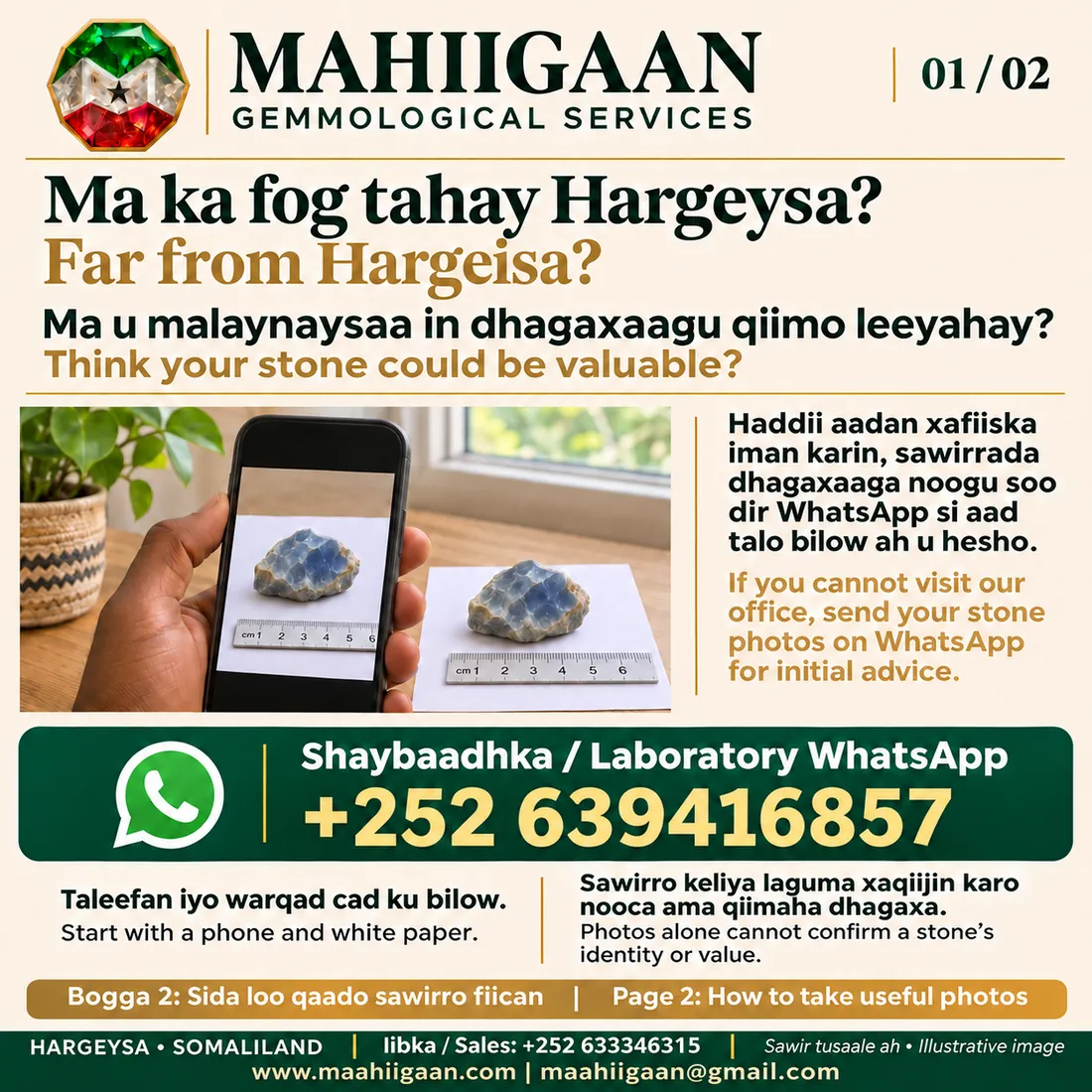
Yes. Send clear photos to the laboratory WhatsApp (see the photo guide below). They help us give initial advice, but cannot provide a final identification or valuation.

What should I bring to the laboratory?

Your stones, clean and dry, any earlier reports, and a note of how you plan to use the report. If you are selling rough, there is no testing fee.

How do I pay?

Payment is made at the laboratory or as agreed on WhatsApp. There are no online payments on this website.

Short lessons

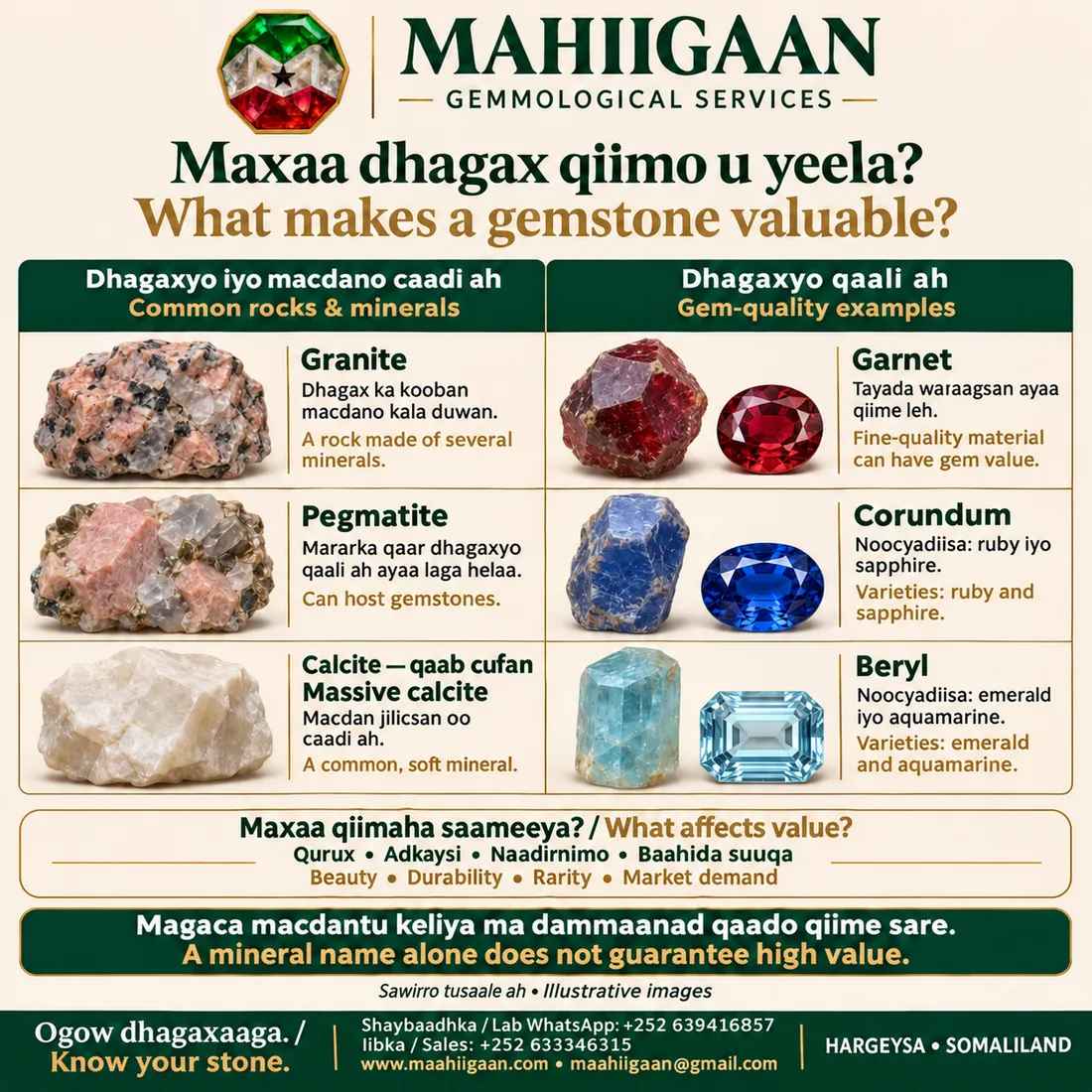
What makes a gemstone valuable?


Education post: common rocks and minerals next to gem-quality examples

What makes a gemstone valuable?

Granite is a rock containing several minerals. Pegmatite has large crystals and can host valuable gemstones. Massive calcite is a common, soft mineral. Garnet, corundum and beryl can have gemstone value when the specimen’s quality is suitable. A mineral name alone does not guarantee a high price: colour, clarity, fractures, size, durability, rarity and market demand all matter. A photograph alone is not enough for a valuation.

View full size
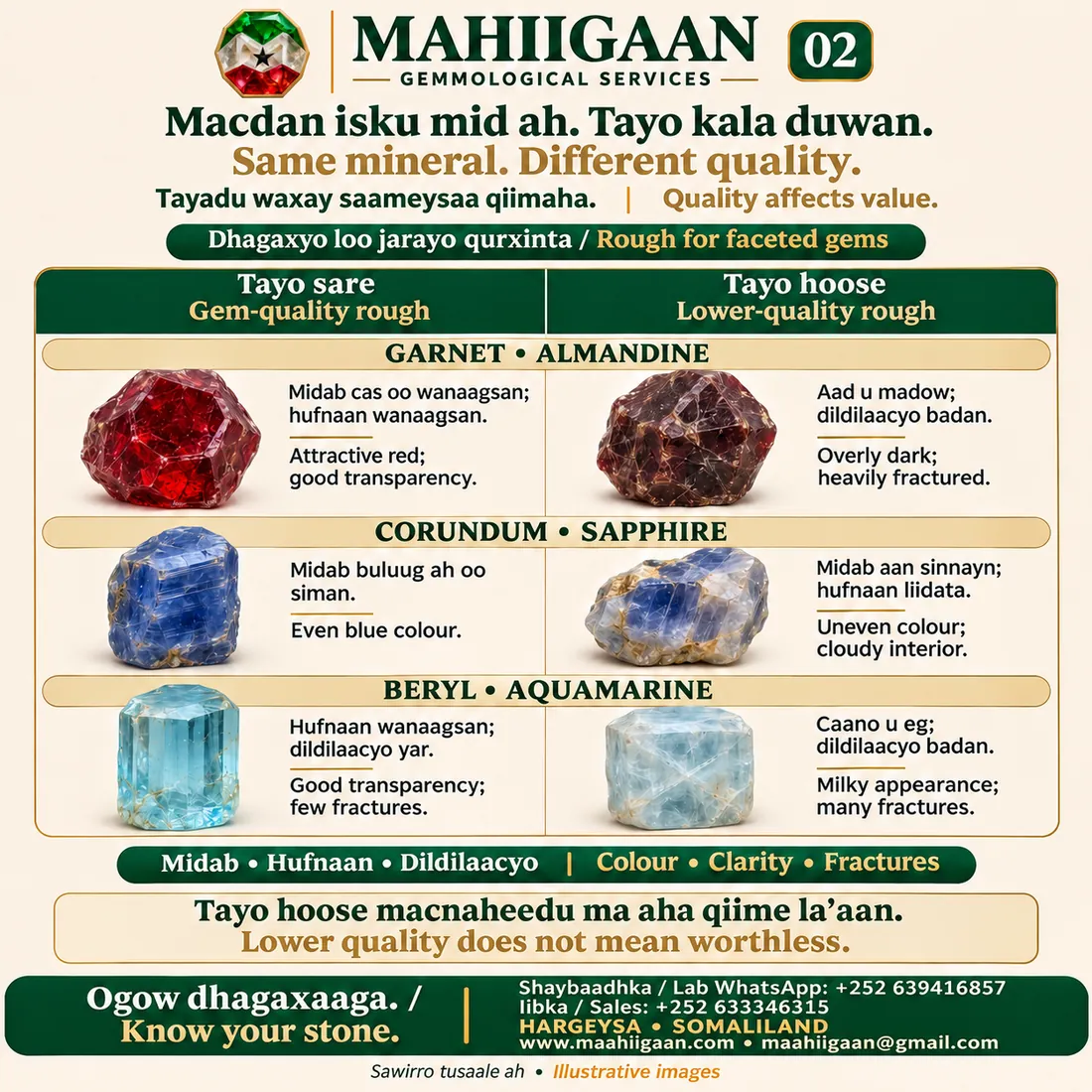
Education post: garnet, sapphire and aquamarine of different quality

Same mineral. Different quality.

Two stones of the same mineral need not have the same value. Attractive colour, transparency and fewer fractures can improve cutting potential. Uneven colour, cloudiness and heavy fracturing can reduce usable material. Lower quality does not mean worthless: material may suit beads, carvings or collections.

View full size
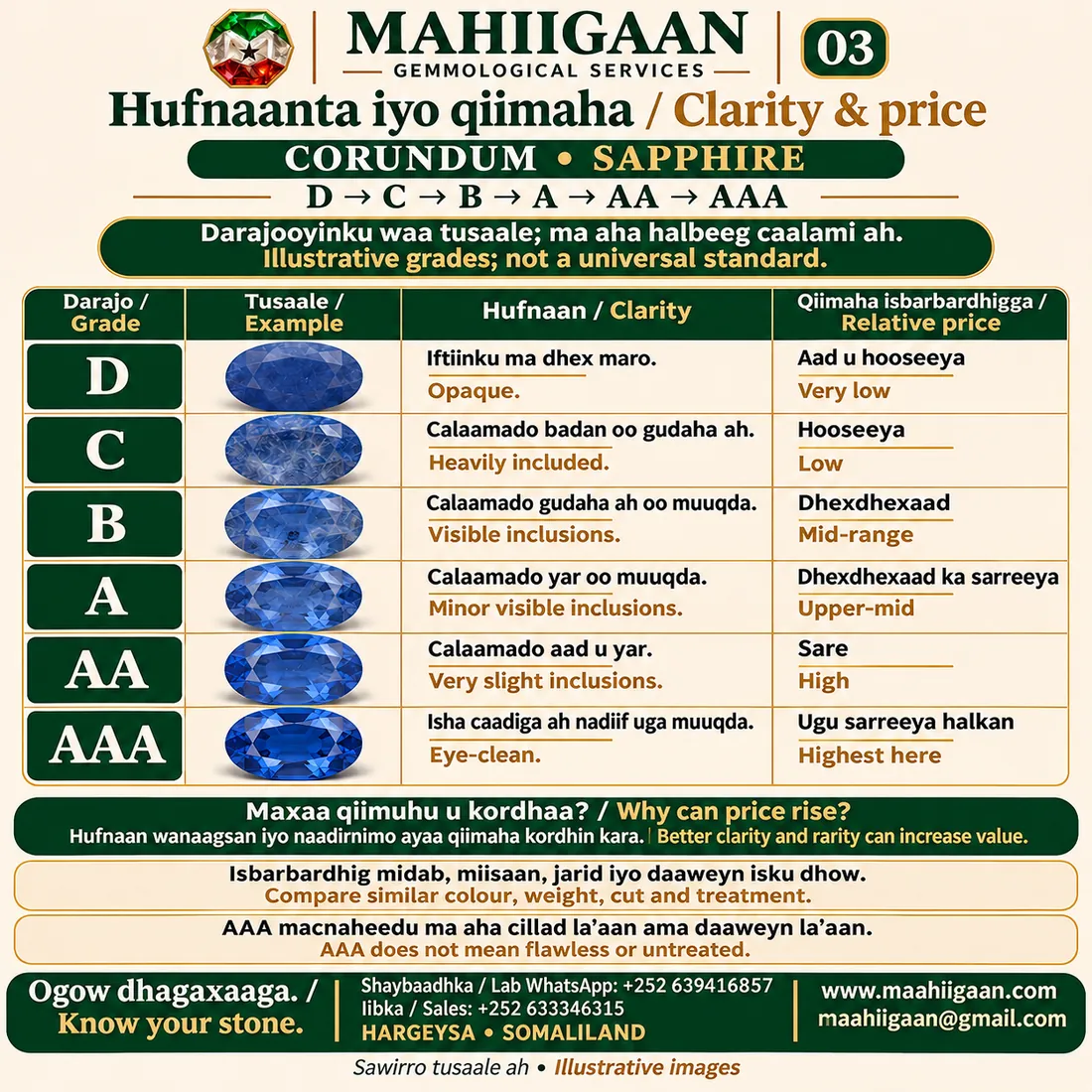
Education post: faceted sapphire clarity and relative price levels

How does clarity affect price?

Inclusions, cloudiness and fractures can affect appearance and value. Better clarity can increase price when colour, weight, cut and treatment are comparable. Seller grades such as D–AAA are illustrative only, not GIA grades or a universal standard. AAA does not mean flawless or untreated.

View full size
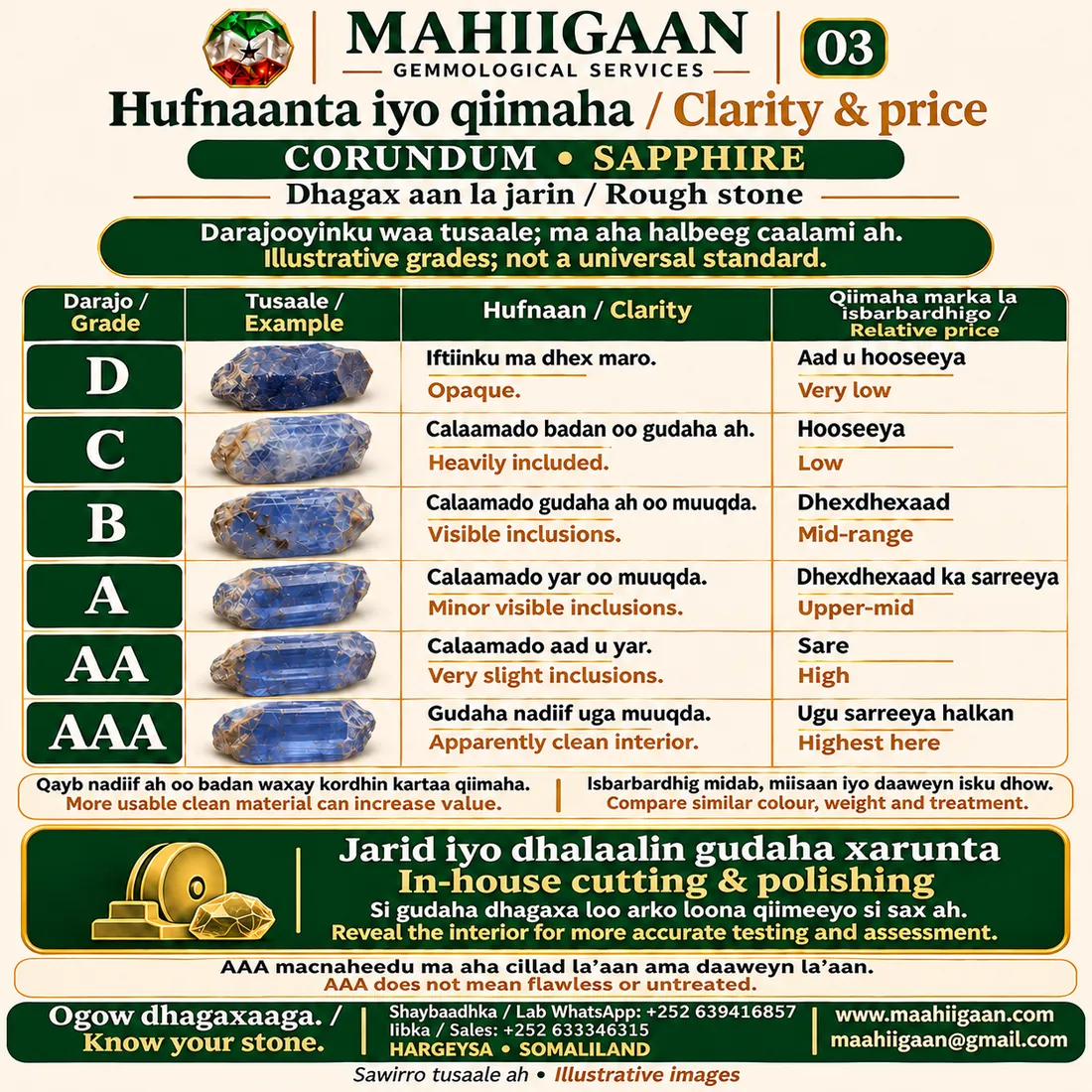
Education post: rough sapphire clarity

Bigger rough does not mean higher value.

A rough sapphire’s surface can conceal inclusions and fractures. Usable cutting yield matters. Maahiigaan offers in-house cutting and polishing to support assessment, after discussing the method and obtaining your consent. It removes material and does not guarantee increased value.

View full size
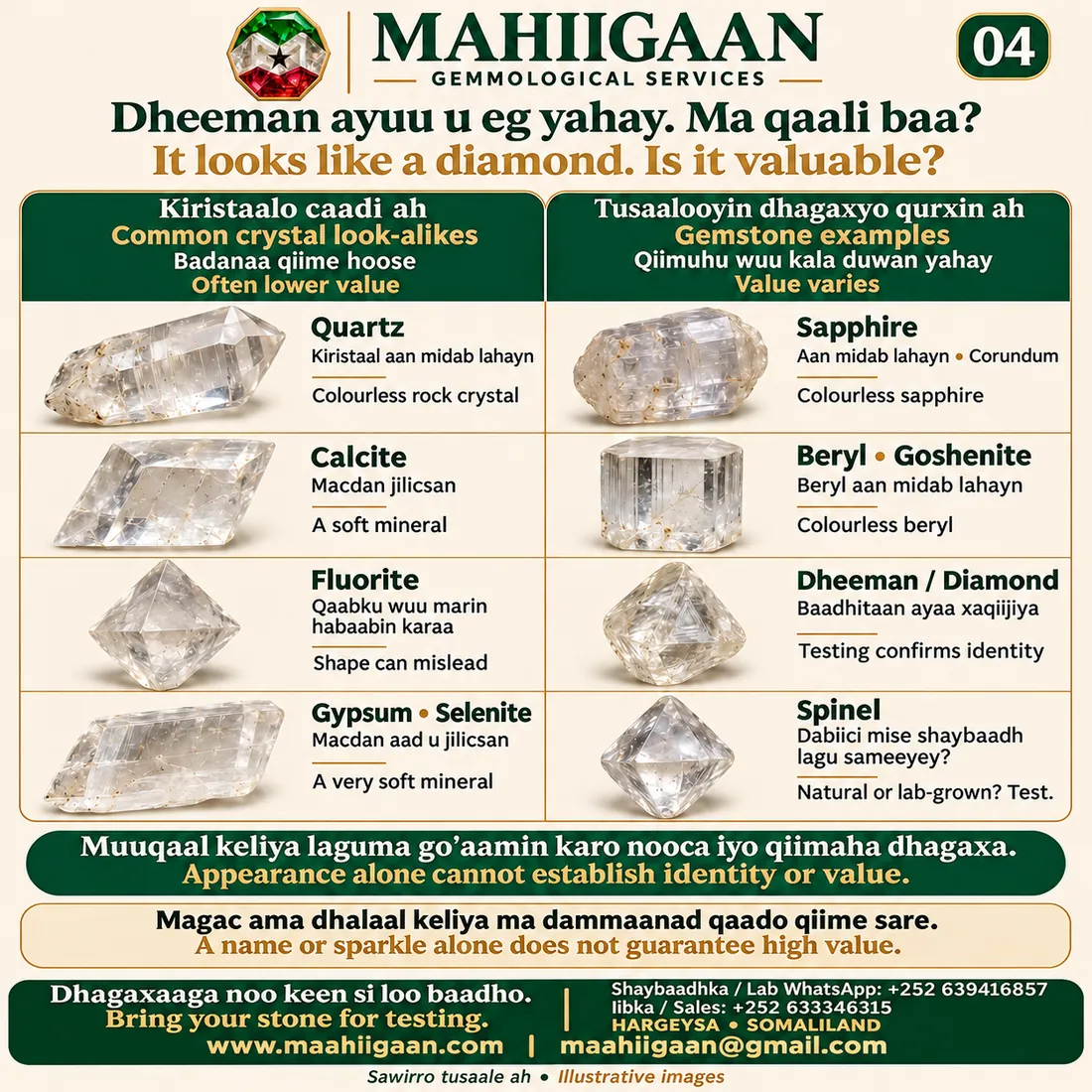
Education post: diamond lookalikes

It looks like a diamond. But what is it?

Sparkle, transparency and crystal shape cannot confirm a diamond. Quartz, calcite, fluorite and gypsum/selenite can sometimes look similar. Colourless sapphire, goshenite (colourless beryl), diamond and spinel vary widely in value. A photo alone cannot establish identity, value or whether a stone is natural or laboratory-grown.

View full size
WhatsApp photo guide

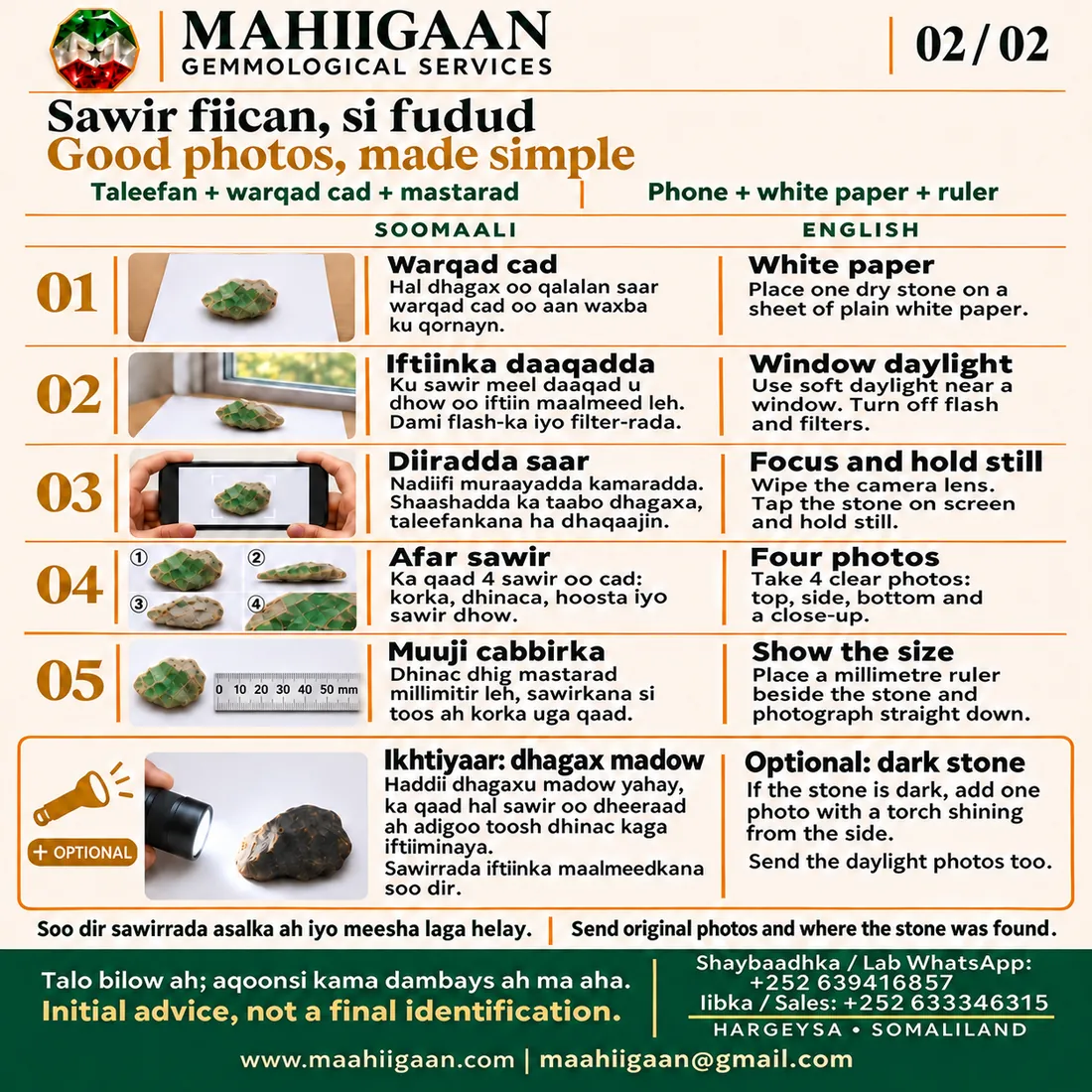
Good photos, made simple: a phone, white paper and a ruler.

  1. 01

    Put one dry stone on plain white paper.

  2. 02

    Use soft daylight near a window. Turn off flash and filters.

  3. 03

    Wipe the lens, tap the stone on screen to focus, and hold still.

  4. 04

    Take four clear views: top, side, underside and close-up.

  5. 05

    Place a millimetre ruler beside the stone on the same surface. Photograph the size view straight down.

Dark stone? Optionally add one photo with a torch shining from the side. Send the daylight photos too.

Send the originals and where the stone was found to the laboratory WhatsApp: +252 639416857. This supports initial advice, not a final identification or valuation.

Photo guide: five steps with white paper and a ruler
View full size
Your certificate explained

What does a gemmological certificate tell you?


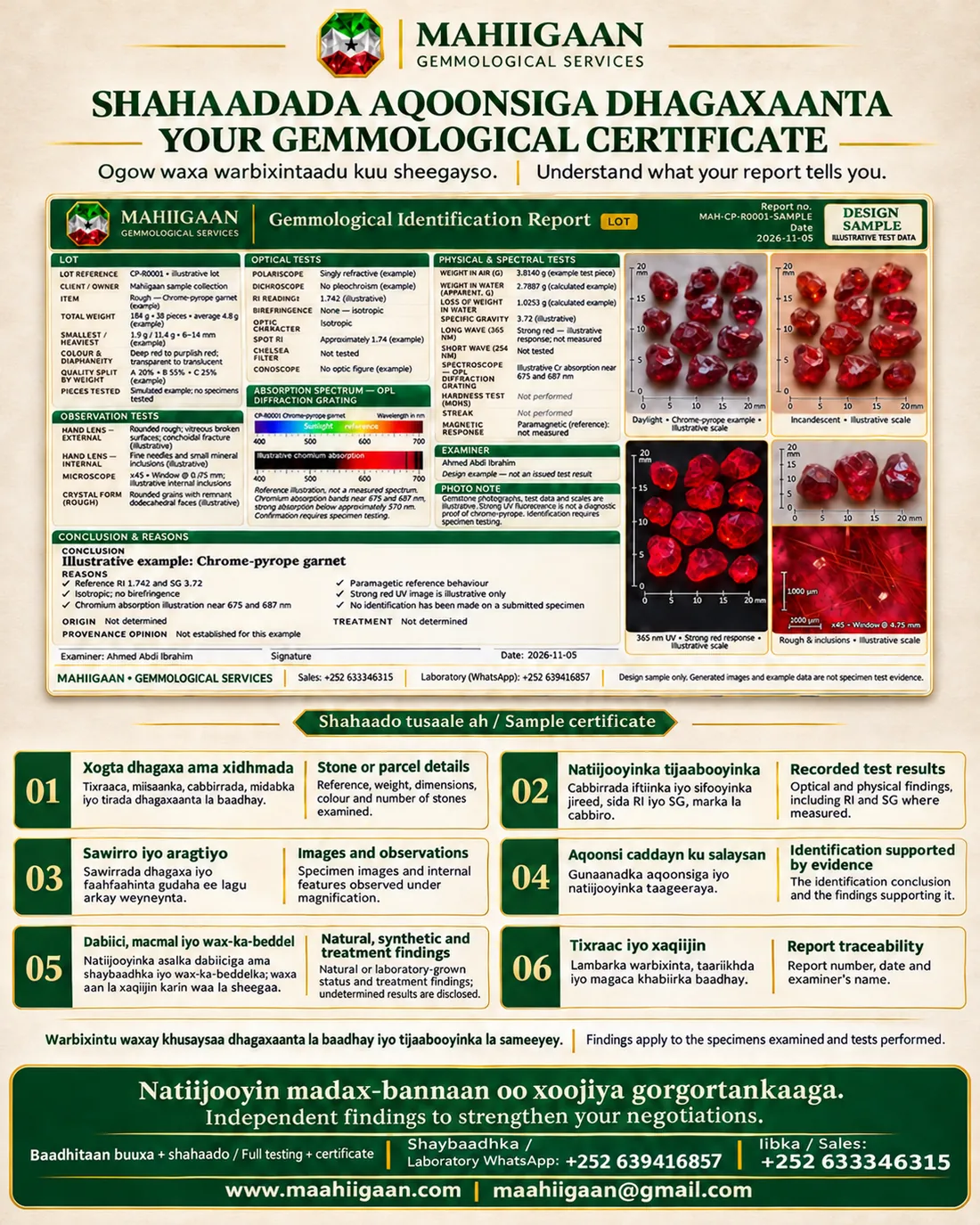
A Maahiigaan report records stone or parcel details, test results, images and magnified observations, and an identification conclusion supported by evidence. Natural, synthetic and treatment findings are reported where they can be established; unresolved findings are disclosed. The report number, date and examiner’s name provide a clear reference.

  • Stone or parcel details: reference, weight, dimensions, colour and number of pieces
  • Recorded test results: RI, SG, UV reactions, absorption spectrum and more
  • Images and magnified observations
  • Identification conclusion supported by evidence
  • Natural, synthetic and treatment findings where determinable
  • Report number, date and examiner’s name

The certificates pictured are design samples (a rough chrome-pyrope parcel and a faceted blue sapphire), not issued results.

WhatsApp